This build is a combination of a main release and its subsequent patch. It is the culmination of our efforts to transform the terrain rendering in the game from 30 year-old tech to modern. And we’re super happy with the result.
The main release delivered:
And the patch brought fixes and memory reductions:
Modernising the engine does, unfortunately, need us to re-visit the minimum specs - modern capabilities, including a 60fps 4k terrain system and new GPU effects demand it unfortunately. It is with that said that a caveat for this release is for players with lower spec machines; you may find that you need to drop the graphics settings from DETAIL.
Our goal is to find the balance between delivering graphical improvements while maintaining access to older, less capable hardware. We will continue to work on optimisations to ensure that min-spec machines can run the game albeit with graphics settings set to “Speed”, which should maintain framerate and stability. The worst case we see right now is older CPUs with 8Gb RAM, integrated graphics and spinning hard drives. This is a demanding setup but this patch introduces memory savings that should help that hardware do a better job of maintaining playability.
We’re going to review and update the minimum and recommended specifications for the game in the next couple of weeks to make sure we’re striking the right balance between supporting older hardware while being able to bring modern features to the engine.
The bulk of the terrain work since our last update has been to drive quality through performance. Performance drives quality because the more tiles we draw the more detail we get and the better the terrain looks - for this first pass we’re topping the quality out at 11 4k textures, each of which needs 4096 tiles. I’m incredibly proud to say that we’ve achieved three orders of magnitude in throughput of tiles. In the original game we ran at 30fps and one tile per frame was drawn - 33 tiles per second. With the new code, on a mid-spec machine we’re seeing 30k+ tiles drawn per second.
We’ve also worked hard on improving the performance of the texture damage system; primarily to maintain stable framerates through flak and fighter attacks, but as a result of that work we’ve been able to increase the amount of damage we’re able to draw on the bombers - should better reflect the punishment these birds absorbed.
I (Crabby) got to choose the aircraft and crew story for today’s update. I chose the B17 that has the biggest impact closest to where I grew up in Wincanton, Somerset, UK.
“Old Faithful” was part of the 401st Bombardment Squadron, 91st Bombardment Group (Heavy), Eighth United States Army Air Force, and was based at Bassingbourn, Cambridgeshire. The aircraft was flown by 2nd Lt. Peter Mikonis and his crew.
“Old Faithful” is believed to have been named after Gene Autry's famous song. The aircraft took part in a bombing mission to southern France, in the area of Toulouse. The mission overall involved bombing an airfield and also dropping supplies to the French Resistance.
The 324th Bombardment Squadron recorded that the group put up a combat wing of three boxes to attack the Toulouse/Blagnac area. In CAVU (Ceiling and Visibility Unlimited) weather, all three boxes reached their assigned M.P.I.s (Mean Point of Impact). The report described this as the group's second outstanding bombing achievement in as many days. It also noted that the result had done much for the morale of the group, whose bombing record of late had been somewhat indifferent.
On the way to the target, near Caen, crews reported seeing a tank battle in progress between the British and Canadians and the Germans. Over the target, the flak was accurate, although there was no enemy fighter opposition.
“Old Faithful” was in the low group lead squadron and took the full force of the enemy flak over Toulouse.
From this point, however, the exact sequence of events becomes difficult to reconstruct.
The aircraft was damaged and fell out of formation, although the available accounts disagree over which engine was affected.
The official 401st Bomb Squadron Daily Diary states that “The aircraft was last seen with its No. 2 engine on fire and appeared to be heading toward Spain”, and Lt. Mikonis and his crew were initially listed as Missing in Action.
A surviving in-flight photograph of “Old Faithful”, however, appears to show damage around the No. 3 engine. The IWM American Air Museum archive also describes the aircraft as being “hit in the #3 engine”.
It is unclear which account is correct. This may simply be an error in the reporting of the aircraft's damage, or it is possible that more than one engine was affected during the aircraft's final flight. By the time “Old Faithful” was last seen, the situation may have changed again.
The dilemma faced by the crew was that if they went to Spain, the aircraft would be impounded and the crew detained for the duration of the war. American and British aircraft were being lost in great numbers, and pressure was put on crews to “bring back the aircraft” wherever possible.
Another account states that all went well until the aircraft approached Lyme Bay, when another engine burst into flames before being extinguished. If accurate, this may help explain the discrepancy between the engine identified in the official reports and the damage visible in the surviving photograph.
Accounts suggest that the aircraft attempted to reach an airfield in the area of the Dorset coast before RAF Zeals, in Wiltshire, was selected as an emergency landing place.
As the aircraft approached Wincanton, the pilot apparently did not realise that RAF Zeals was on the other side of high ground. The aircraft continued towards the area while flying very low.
Local people who witnessed the final moments recalled that the aircraft appeared to be heading towards a populated part of Wincanton. They reported that the aircraft was full of holes and appeared to be almost falling apart. The crew then appeared to attempt to bank the aircraft to the right. The crew were also reportedly seen throwing out anything that could lighten the aircraft, like guns and radio equipment.
The aircraft came down over Snag Farm, Wincanton, and all nine members of the crew were killed. Michael Watts, was 11-years- old when he heard the bomber crash into his family’s farm. “My brother and I were making a den in a field and my sister was outside. It happened quick as a flash. We heard a bang, then turned around and all we saw was a ball of flames. We ran like the clappers, then we saw the wreckage, smack bang in the middle of the cow yard. It put the milking hall out of action for weeks and I remember people coming and bringing their buckets down to milk our cows themselves. We had a large pig as well which was being fattened up for Christmas. Nobody could work out how it got out of its barn. Then, under the hay we found part of “Old Faithful’s” propeller blades in its trough.”
There are differing accounts of what happened in the aircraft's final moments. Some local eyewitnesses recalled seeing “Old Faithful” explode, while other accounts describe a wing shearing off before the crash. The wing-shearing account appears in several of the available official military records and may therefore be the more likely explanation, although it is impossible to know exactly what those on the ground saw in the confusion of the crash.
The crew that flew “Old Faithful”’s last mission:
SGT Cyril Powers was not on this mission. He had previously flown as the crew's tail gunner, but the reason he was not flying with them on this occasion is unknown.
Brave the deadly skies of occupied Europe!
Join the discussion https://discord.gg/7ZacVDyP
This build contains major improvements to two key flight AIs.
A special shout-out goes to Matty (@esmatty), Tom (@Crabby) and Erik (@Stadl0r) for all of their help with this build.
It's a simple story of a B-17 first assigned to Vern L. Moncur on 23 January 1944 and retired March 22, 1945.
She shepherded 583 airmen through 112 combat missions and brought them all home injury free. A truly astonishing accomplishment.
After her first tour she was assigned as a "new crew" or "first mission ship" to get crews off to a good start. Mission accomplished!
Brave the deadly skies of occupied Europe!
Join the discussion https://discord.gg/7ZacVDyP
This patch updates gameplay and UI with some other minor fixes, tweaks the fighter behavior and new time bar and fixes a very serious CTD mid-mission.
B-17 serial 42-32076 was accepted into service in January 1944 arriving in Great Britain on the 2nd of March. It was flown from RAF Bassingbourn by the 401st bombardment squadron of the 91st bombardment group. Dubbed 'Shoo Shoo Baby' by its crew after a popular song by the Andrews Sisters, it flew 24 successful missions, before mechanical problems deep in enemy territory forced the crew to land the Aircraft in neutral Sweden where it was interned. A deal was struck between the US and Sweden to gift several B17's to Sweden for civilian purposes including the (renamed) 'Shoo Shoo Shoo Baby', in return for repatriation of air crew.
Shoo Shoo Shoo Baby is one of a handful of surviving B17's today.
This patch fixes a Crash and Start Mission Issue.
This patch fixes several AI issues and includes some Quick Mission and Front End enhancements.
Note: Flak damage severely impacts the aircraft control surfaces, which impacts the bomber's ability to maintain formation positioning currently. We're aware of this and are continuing to work on improvements to this.
Please keep the feedback coming and follow the game on social and on the major gaming platforms for the latest updates.
This fix patches several 'quality of life' issues
Please keep the feedback coming and follow the game on social and on the major gaming platforms for the latest updates.
This is a hot fix for a crash bug when accessing a station with a missing crewman
This week we have focused on issues with AI and physics timing, as well as some quality of life improvements to the bombing
Please keep the feedback coming and follow the game on social and on the major gaming platforms for the latest updates.
This patch includes fixes for several serious issues:
This build contains user modifiable nose art and control changes
In 1943, Clark Gable, star of 'Gone With The Wind' was one of Hollywood's most famous actors. After the death of his wife in a plane crash in 1942 he enlisted in the Army Air Forces, joining the 8th Air Force. He flew as a gunner and cameraman on several missions.
On 12th August 1943, he was gunner in B17 #42-29863 'Ain't it Gruesome' in a raid over Germany. He had wedged himself behind the top turret gunner for a better view. He almost lost his life when a 20mm shell went through the flight deck, removing the heel of his shoe and missing his head by 30 cm.
The footage collected by Gable and his crew was used to produce 'Combat America', a documentary on B17's used to promote war bonds.
Brave the deadly skies of occupied Europe!
This release incorporates the fixes identified by our Discord community. Special thanks to them for finding and reporting a number of transition crashes, both with full information and full respect.
Do you also want to be part of a special community?
Join our discord today!
In October 1943, during a raid on Munster, waist gunner George Rankin narrowly saved his crew when a German rocket came through the waist window. He quickly grabbed the spluttering rocket and threw it back out, where it exploded in flames below.
Later, pilot Bruce Riley skilfully landed the plane in a manner that could have been straight out of a Hollywood movie. With less than two minutes of fuel remaining, two non-functional engines, and no radio assistance, Riley managed to land safely in dense fog with almost no visibility.
Brave the deadly skies of occupied Europe!
It was radio operator Forrest Vostler's fourth mission in B-17 42-29664 'Jersey Bounce Jr' on a mission to Bremen. After the B-17 had bombed its target, it was damaged by Antiaircraft fire and forced out of formation, making it a target of opportunity for German fighters.
The aircraft was hit by multiple 20mm cannon shells, two of which exploded in the radio compartment, severely damaging Vostler's legs, chest and face, including shrapnel in his eyes.
The severely damaged aircraft limped most of the way home, with the crew jettisoning any extra weight they could.
Despite both sets of injuries Vostler kept firing at the enemy, and then after the pilot announced they would have to ditch in the channel, although he could barely see and was barely conscious he managed to fumble around with the damaged radio enough to send a distress signal.
Due to Vostler's actions all crew survived. For his bravery he was awarded the congressional medal of honor.
Brave the deadly skies of occupied Europe!
This patch contains new high definition B17s
B-17 F 41-24485 'Memphis Belle' was named after pilot Robert K. Morgan's sweetheart, Margaret Polk, who lived in Memphis Tennessee. It was one of the first B17's to complete 25 combat missions, after which it was returned to the United States to help sell war bonds. It inspired two films, a 1944 documentary, and a 1990 feature film. It was restored in 2005 and is on display at the National Museum of the United States Air Force in Dayton, Ohio
Ensure you follow the game for updates on the roadmap and patch notes.
This patch contains major fighter and AI changes
B17 42-31499 'Susan Ruth' was one of 20 B17s from the 306th bombardment group to bomb the Frankfurt rail yards on 8th February 1944. It was damaged by flak over the target, but remained flyable, however the bomber was targeted by two German fighters over France, killing the radio operator and the ball turret gunner, and forcing the rest of the crew to bail out of the mortally wounded aircraft.
Scattered over the countryside, 5 of the surviving crew managed to evade capture for a while with the help of Belgian and French resistance, but 3 were eventually captured and executed by Nazi partisans. Too injured to make the arduous journey over the Pyrenees to Spain and allied Gibraltar, the pilot, Howard J Snyder, joined the 'The Maquis', a local resistance group, and continued to fight the Nazi regime from the ground until liberated by US troops months later.
This patch contains UI updates and a crash fix
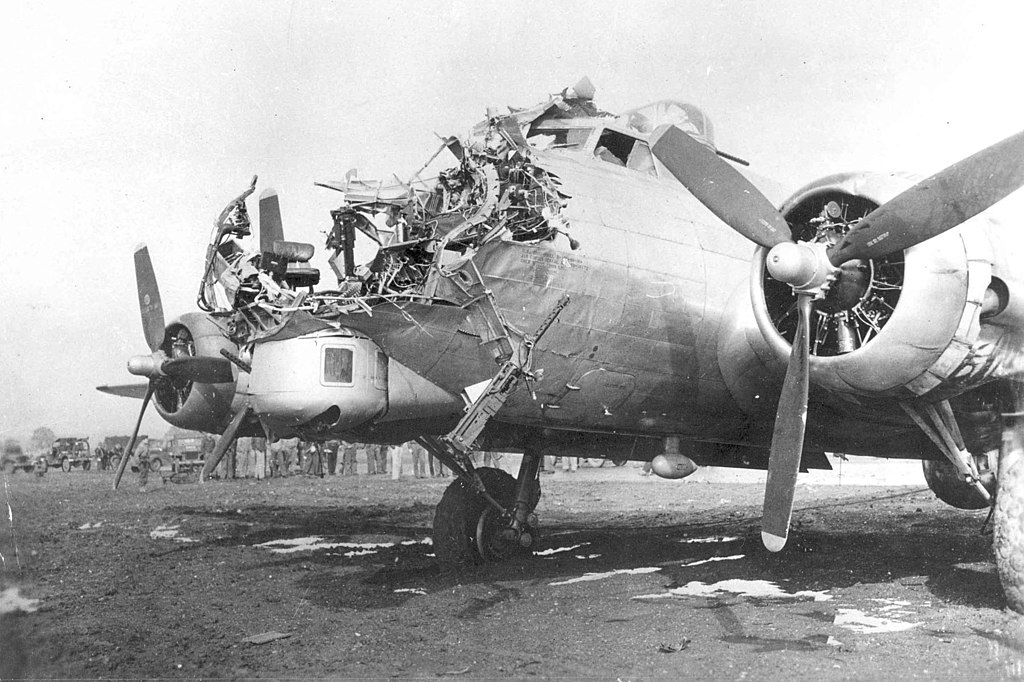
B-17 serial 43-38172 'Lovely Julie' took a direct flak hit over Cologne, blowing off almost the entire nose, killing the bombardier, Sgt George Abbott, and destroying instruments and the oxygen supply.
The pilot, Lawrence DeLancey managed to drop to a lower altitude while still under fire, and nurse the bomber home, making a safe landing despite sub zero winds and no brakes.